
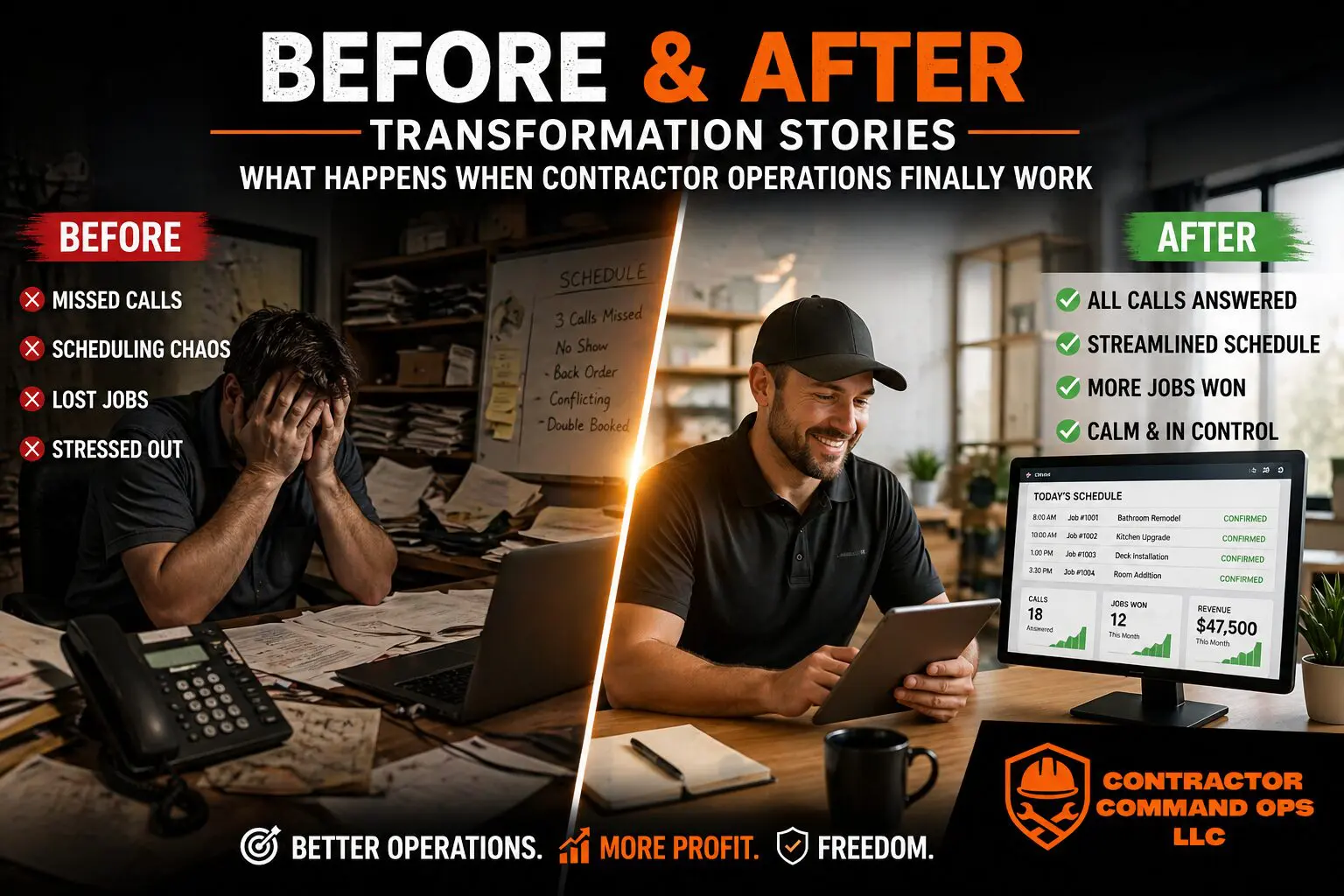
Before & After Transformation Stories: What Happens When Contractor Operations Finally Work
Most contractors don’t realize how broken their operation is until they see what it looks like when it actually works.
They think missed calls, scheduling chaos, and slow response are just part of the business.
They’re not.
When the system changes, everything changes.
Before: What Most Contractor Operations Look Like
Before transformation, most contractor offices operate in reaction mode.
There is no real control, only constant problem-solving.
Common signs include:
- Missed calls and delayed responses
- Overloaded office staff
- Scheduling confusion and double bookings
- Technicians waiting or driving inefficiently
- Leads falling through the cracks
The Hidden Cost of Staying the Same
These problems don’t just create stress. They cost real money.
Most contractors underestimate how much revenue they lose every month.
This leads to:
- Lost high-value jobs
- Lower customer satisfaction
- Inconsistent daily revenue
- Burnout across the team
The Turning Point
Transformation starts when the focus shifts from more leads to better operations.
Instead of asking how to get more calls, the question becomes how to handle every opportunity correctly.
That shift changes everything.
After: What a Controlled Operation Looks Like
After transformation, the business operates with structure and consistency.
Instead of reacting, the system guides every step.
The operation becomes:
- Fully responsive to every incoming lead
- Organized with clear scheduling
- Efficient in technician utilization
- Consistent in customer communication
- Predictable in daily performance
Before vs After: The Real Differences
The difference is not subtle. It is operational control.
Before:
- Missed opportunities
- Slow response times
- Chaotic scheduling
- Unpredictable outcomes
After:
- Every call handled
- Immediate response
- Controlled scheduling
- Consistent results
What Actually Drives the Change
The transformation does not come from hiring more people or adding more tools.
It comes from building a system that removes inconsistency.
That includes:
- Automated response handling
- Structured scheduling systems
- Clear communication workflows
- Clear communication workflows
Why This Matters for Growth
Growth without control creates more problems, not more profit.
When the operation is stable, growth becomes scalable.
That is when contractors move from struggling to predictable success.
Final Thought
Most contractors are closer to transformation than they think.
The opportunity is already there in the leads they are not handling correctly.
Fix the system, and the results follow.
